

Unveiling the life of a Kimono
What I have long wanted to do is to bring forward the potential of Japanese kimonos, designed by our predecessors, as one of the most sustainable forms of fashion of all time.
Kimonos are made from a single bolt of fabric measuring approximately 12 meters in length. The material may be silk, cotton, hemp, wool, or even synthetic fibers. One of the most remarkable aspects of the kimono is that it was designed to last for generations—upcycling is built into its very structure.
The basic form of the kimono has remained largely unchanged since the late Heian period in Japan, around the 900s. Luxurious kimonos were worn by court ladies, who needed new and different garments for each season—or even each month—to display their wealth. Once worn, these kimonos were passed on to others who could not afford to commission new ones.
The 12 meters of fabric are cut into rectangular pieces: two sleeves, two body panels (front and back), two collar pieces, and two center-front panels. Because all parts are rectangular, a kimono can be completely taken apart and reconstructed back into its original bolt of fabric whenever alterations are needed.
This ability to reconstruct a kimono back into a bolt of fabric is what makes it so exceptional in terms of longevity and sustainability. When a kimono needs to be shortened, seamstresses use techniques to adjust the length without cutting the fabric, allowing it to be re-sized it as needed. Over time, used kimonos could be transformed into children’s clothing or further upcycled into cushion covers, futon covers, or any item requiring fabric. Kimono upcycling is not a new concept—we simply forgot about it as Japan became industrialized and increasingly materialistic, surrounded by mass-produced goods.
In earlier times, kimonos were passed from person to person and from generation to generation, holding a valuable place in people’s lives. They were often included as part of a bride’s dowry, with parents purchasing expensive kimonos for their daughters. In times of financial hardship, a kimono could be exchanged for food or shelter, serving as a means of survival.
Today, we find an abundance of kimonos in the secondary market, and once again we are rethinking how to upcycle them. However, there is a key difference: many of these kimonos have barely been worn—or not worn at all—before being directly transformed into Western-style clothing.
As kimono lovers, we have mixed feelings about kimonos which are not worn at least a few times in their original form before being turned into something else. This is why, at Aine, we see this as mottainai—a Japanese word and concept used when something is wasted without its full potential being realized. Yes, we believe in upcycling. Yes, we also believe in wearing kimonos as kimonos. And yes, a kimono does not have to be worn only in its traditional way—it can be styled like a Western style dress without being permanently altered into one.
I recently had the opportunity to meet Corinna (@romyhood) at Maison Shift in Zurich. With her deep knowledge of sustainable clothing, she already has a strong understanding of kimonos. We explored how a kimono can be worn in a modern way. Drawing on draping techniques I have learned and practiced, I styled the garment directly on her body, allowing the traditional kimono to unfold into a contemporary, European silhouette. Corinna wore it with ease and confidence, reinforcing my belief that this approach truly works in a city like Zurich.
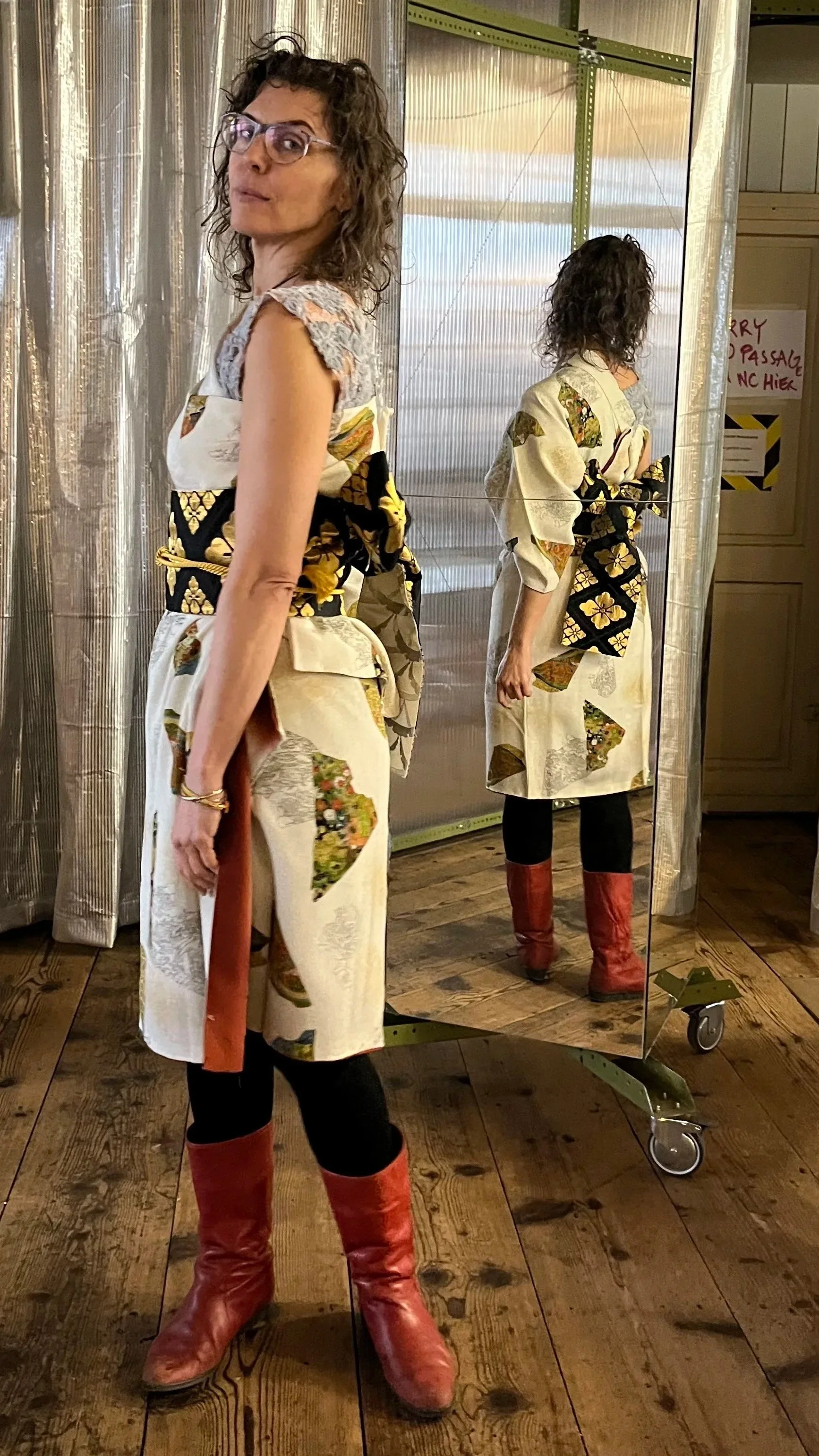
@romyhood wearing a “kimono-dress” styled by @unveil_aine
